
Home / Guides / That bang was the torsion spring
GUIDE · URGENT READING
That bang was the torsion spring
A single loud bang from the garage, sometimes loud enough to check the street for a car accident. Then the door won't lift, or the opener strains and gives up. Here's what happened, why it was always going to happen, and what to do in the next ten minutes.
What just happened
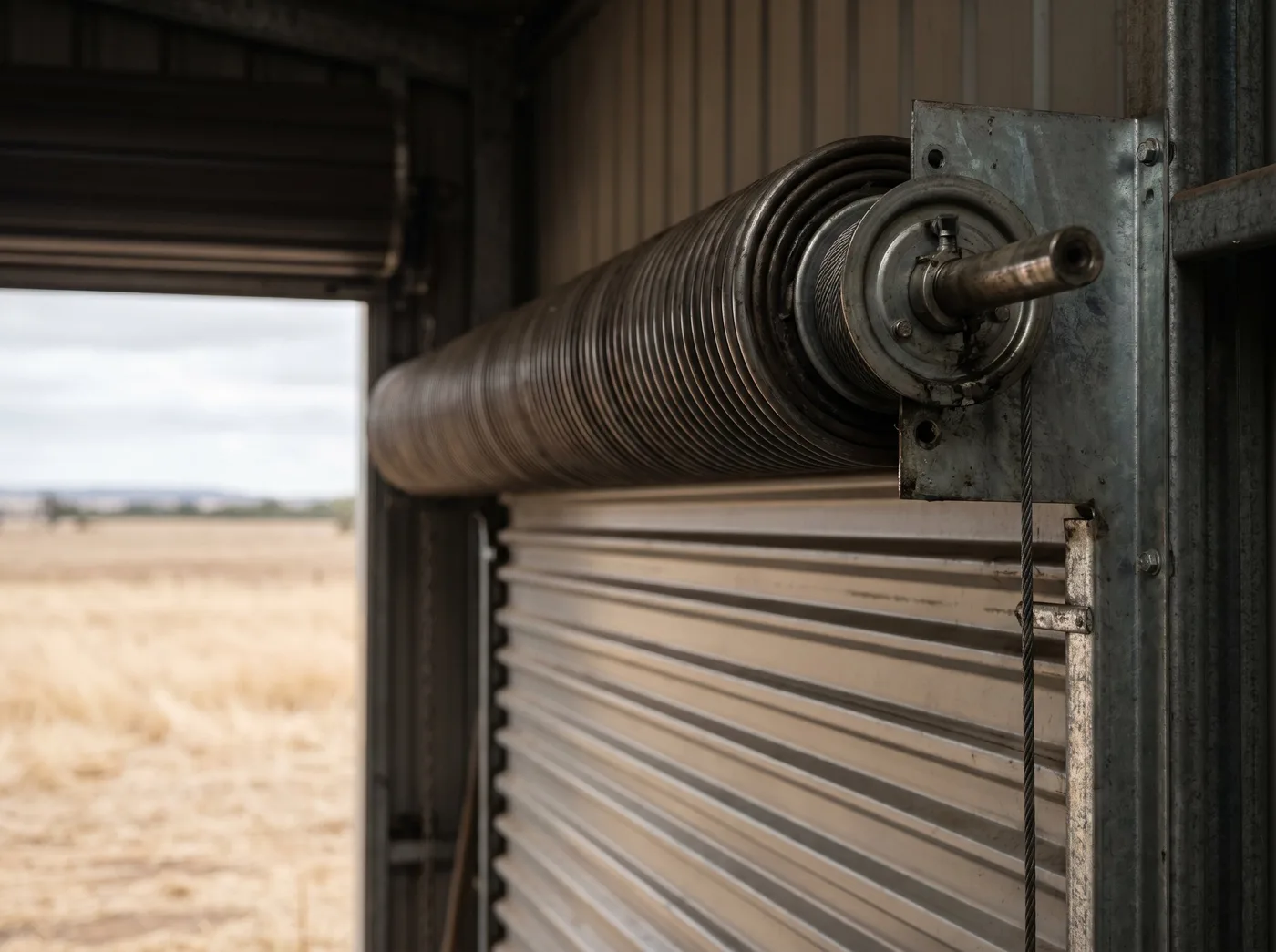
Above your door there's a shaft with a big coiled steel spring on it. That spring is wound to a tension that counterbalances the door's whole weight, often over a hundred kilos on a double sectional. It does the real lifting every time the door opens; the opener just steers and brakes.
Steel that's wound and unwound thousands of times eventually fatigues, and when a torsion spring lets go it releases all of that stored energy at once. That's the bang. The shaft contains the spring, which is why the failure is loud but almost always harmless in the moment. The problem is what comes next: your door has become dead weight with nothing carrying it.
Don't lift the door by hand. It's far heavier than it has ever felt. Don't run the opener: it can strip its drive trying, or drop the door. Don't pull the red manual-release cord if the door is up: with no spring holding it, the door can fall. Keep kids and dogs clear, leave the door where it is, and book the repair.
Why it snapped: the cycle rating
Springs don't fail randomly; they wear out on a schedule. A standard torsion spring is rated around 10,000 cycles, one cycle being a full open and close. A family garage that opens three or four times a day burns through that in roughly seven to ten years. If your house runs on shift rosters, with the door cycling before dawn and again after a swing, you can be at the front end of that range without anything being wrong.
Singleton adds its own tax. Dust on the coils accelerates wear between the windings, and the daily swing from cold dawns to 30-degree afternoons works the steel that little bit harder than milder country does. It's not dramatic, but over ten thousand cycles it adds up.
The spring didn't break because something went wrong. It broke because it finished the job it was rated for. The question is just whether it gets replaced before or after it strands the car.
What the repair visit looks like
Spring replacement is genuinely not a DIY job: the new spring has to be wound to tension, and getting that wrong is how people get hurt. A proper visit replaces the failed spring (usually both, on a two-spring door, since they've done the same mileage), checks the cables and drums that took the shock, rebalances the door, then resets the opener's force limits and tests the safety reverse so the motor isn't fighting a door it no longer understands.
On an older door, the honest version sometimes includes a second option: if the panels, pivots or tracks are near the end too, you'll get a replacement figure beside the repair figure and the call stays yours.
FAULT · SPRING SYSTEM
Door down, spring gone?
Tell us what you heard and whether the car's inside. Spring jobs go to the front of the queue.
Book the repairReferences
- ACCC Product Safety: garage door openers. Recalls and safety notices for opener models; worth a check if your opener is older or second-hand.
- AS/NZS 60335.2.95. The Australian safety standard covering powered garage door openers, including the auto-reverse behaviour that protects people and pets; we test that reverse as part of every spring repair.